CIMA Exam Structure: The Full Syllabus Explained
The CIMA professional qualification has three levels - Operational, Management and Strategic - each with three 90-minute Objective Tests and one 3-hour Case Study exam, sitting above an entry-level Certificate in Business Accounting. Content is organised into Enterprise, Performance and Financial pillars, and you must pass all three Objective Tests before attempting a level's Case Study.
The CIMA qualification has a transparent and progressive structure, designed to build business finance and strategy competency. It starts with a foundation Certificate and progresses through three professional levels - Operational, Management, and Strategic - each with Objective Tests and a Case Study exam.
(Note that the CIMA FLP path has important differences. See our article here for more info).
1. CIMA Qualification Levels & Exam Components
CIMA Qualification Structure at a Glance
Level
Exams Required
Outcome
Certificate in Business Accounting
4 Objective Tests (BA1-BA4)
Entry-level diploma; foundation
Operational
E1, P1, F1 Objective Tests + Operational Case Study
Diploma in Management Accounting
Management
E2, P2, F2 Objective Tests + Management Case Study
Advanced Diploma in Management Accounting
Strategic
E3, P3, F3 Objective Tests + Strategic Case Study
Full CGMA-qualifying exam
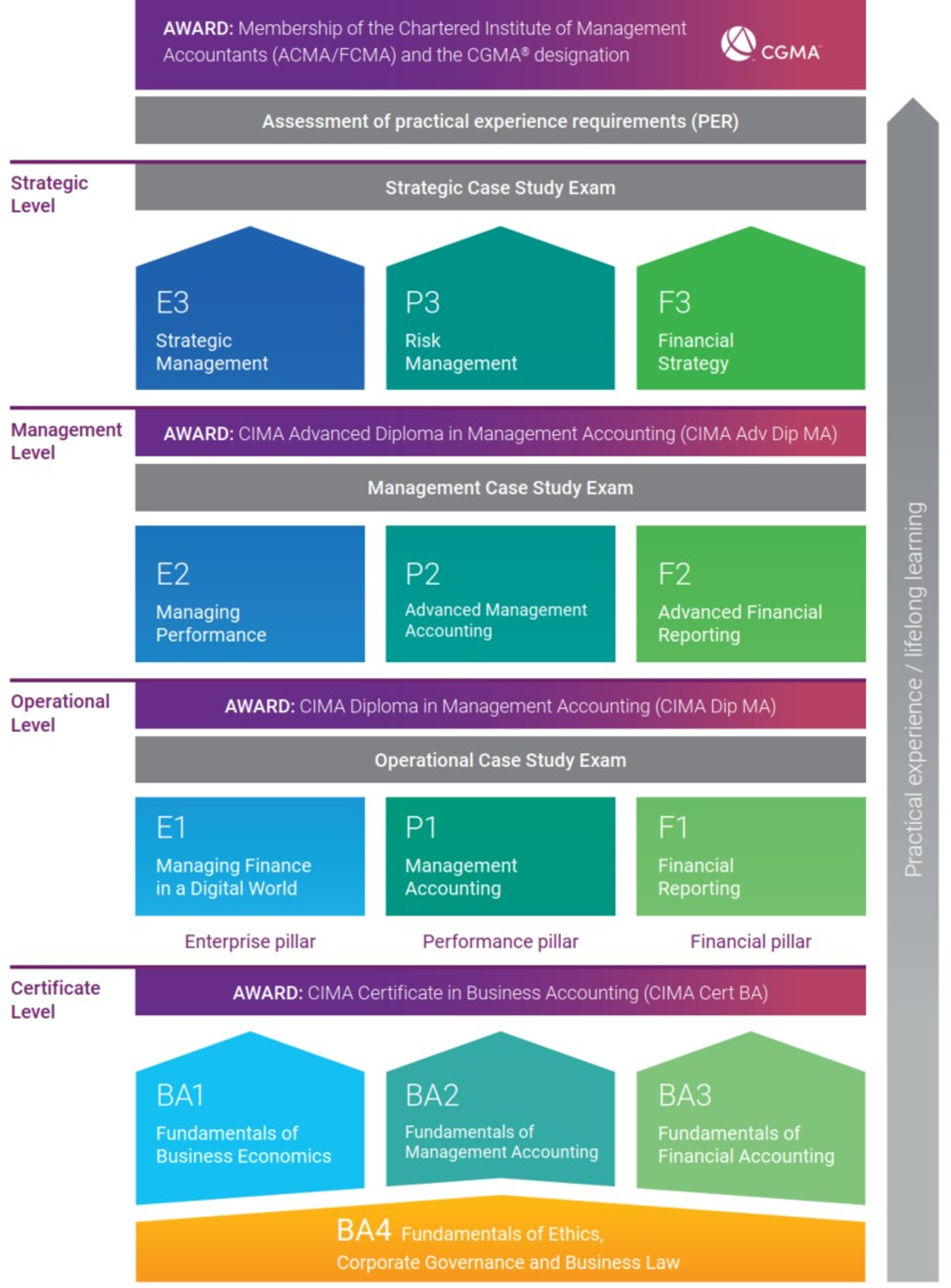
Image courtesy of CIMA
2. Knowledge Pillars Across Levels
CIMA’s syllabus organises its professional content across three pillars:
- Enterprise (E): Strategy, organisational structure, change
- Performance (P): Management accounting, budgeting, risk
- Financial (F): Reporting, financial strategy, governance
This structured progression ensures you develop integrated competencies from operational details to strategic decisions (more info here).
3. Exam Format & Sequencing
- Objective Tests:
- 90 minutes, computer-based, on-demand for each subject
- Pass all three before attempting the Case Study
- Case Study Exams:
- 3 hours, taken at each level, four windows annually (Feb, May, Aug, Nov)
4. Study Route Options
CIMA Study Routes
Route
Description
Traditional Exam Route
Self-study (or tuition provider support), completing Objective Tests and Case Study exams at each level.
FLP (Finance Leadership Program)
A guided, digital-first study route with embedded assessments. Covers the same content and levels, but delivers learning and assessment in an integrated online program.
The content remains consistent; only the assessment delivery differs.
5. Tips for Candidates
- Take Objective Tests first. You must pass them before sitting any Case Study exam
- Understand how pillars interconnect. For example, the E1 → F1 → P1 sequence builds on knowledge logically and leaves the P1 exam as the final one before the Operational Case study, which tends to test more P1 topics than E1 or F1 topics. That way, your P1 knowledge is likely to be freshest in you mind
- Plan for Case Study windows. Booking strategies, exam readiness, and timetable alignments matter.
FAQs: CIMA Exam Structure
How is the CIMA qualification structured?
The CIMA qualification consists of a foundation Certificate in Business Accounting followed by three professional levels-Operational, Management, and Strategic. Each professional level has three Objective Tests and one Case Study exam.
What are the CIMA exam formats?
Objective Tests are 90-minute computer-based exams, available on demand throughout the year. Case Study exams are 3 hours long, based on a pre-seen scenario, and are held four times a year (February, May, August, November).
What are the three knowledge pillars in CIMA?
CIMA is structured around three knowledge pillars: Enterprise (E), Performance (P), and Financial (F). Each pillar builds from Operational through to Strategic level, ensuring a progressive learning journey.
Do I need to complete Objective Tests before Case Study exams?
Yes. You must pass all three Objective Tests at a level before attempting the Case Study for that level. For example, you must pass E1, P1, and F1 before sitting the Operational Case Study exam.
What qualification do I earn at each level?
After passing the Operational level, you receive the CIMA Diploma in Management Accounting. At the Management level, you receive the Advanced Diploma. At the Strategic level, you become eligible for CGMA designation, upon completion of practical experience requirements.
What study routes are available for CIMA?
You can follow the traditional exam route (Objective Tests + Case Studies) or the Finance Leadership Program (FLP), a digital study route with integrated assessments. Both lead to the same CIMA qualification.
Frequently asked questions
How is the CIMA qualification structured?
It starts with the Certificate in Business Accounting, then progresses through three professional levels: Operational, Management and Strategic. Each professional level has three Objective Tests plus one Case Study exam.
What are the CIMA exam formats?
Objective Tests are 90-minute computer-based exams you can sit on demand year-round. Case Study exams last 3 hours, are based on a pre-seen scenario, and run in four windows each year: February, May, August and November.
Do I need to complete Objective Tests before Case Study exams?
Yes. You must pass all three Objective Tests at a level before sitting that level's Case Study - for example, E1, P1 and F1 before the Operational Case Study.
What study routes are available for CIMA?
You can take the traditional exam route of Objective Tests and Case Studies, or the Finance Leadership Program (FLP), a digital route with integrated assessments. Both cover the same content and lead to the same qualification.
Related guides
CIMA Pass Rates: The Most Recent Numbers
The most recent CIMA pass rates published: Case Study exams run 53-71% by window, Objective Tests range from 44% (P2) to 83% (E1). Full tables inside.
Updated June 2026
CIMA Exam Dates: Upcoming Windows and How to Book
All CIMA Case Study exam dates for 2026: August and November windows, pre-seen release dates, scheduling deadlines and results days for OCS, MCS and SCS.
Updated June 2026
CIMA Approved Calculators: What's Allowed
Which calculators are allowed in CIMA exams? Scientific or solar-powered models with basic memory are fine; graphical and programmable ones are banned.
Updated June 2023